
Zihan Zhou’s Interview
Starting date: 16.12.24
Nationality : Chinese
Implementing Partner : TUM
Main supervisor: Christopher Garvey, Wiebke Lohstroh
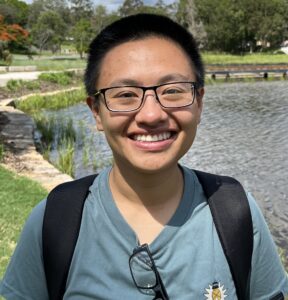
Few words about you and your research project
My name is Zihan Zhou, I joined as GNeuS post-doc with Technical University of Munich (TUM) in call 3.
The system I’m focusing on in the project is the lipid bilayer, the fundamental structure of the cell membranes of every living organism.
Because of the importance of cell membranes to the functioning and survival of cells, the properties of lipid bilayers have long been a topic of interest. But due the high level of disorder, fluid phase lipid bilayers are quite difficult to study in detail with experimental techniques.
To understand these systems in atomic detail, it is necessary to combine experimental approaches with modelling. In particular, combining atomistic molecular dynamics (MD) simulations with scattering can be highly complementary.
However, the validity of these MD simulations and thus their utility in understanding biological membrane is dependent on the accuracy with which interatomic forces are described. This makes validating lipid force fields against experimental data a key issue.
In this project, I am interested in comparing simulation and scattering experiments of bilayer systems to validate force field models in simulation.
As part of the project, I have 3 secondments planned: one at Institut Laue-Langevin (ILL) in France, one at the University of Queensland in Australia, and another with HORIBA Scientific in Munich.
What is your background? How have you heard about GNeuS?
My research background is primarily in molecular dynamics simulations.
Before joining GNeuS, I did my PhD studies at The University of Queensland in Australia. During my PhD, I worked towards developing a generalisable atomistic force field that can reliably model lipid bilayers as well as other organic and biological molecules of interest.
As part of that, a bottom-up approach was taken in which force field parameters for small molecule analogues of membrane lipid components were re-parameterised using direct parameter space mapping.
A key element of the work was minimising confounding factors that impact model transferability during parameter fitting e.g., ensuring that the simulations are performed in a regime that reduces their sensitivities to the precise choice of simulation settings, and explicitly considering the correlations between different force field parameters.
I first heard about the GNeuS project from Dr Christopher Garvey at TUM.
Why did you apply specifically on GNeuS?
There were plans for me to perform neutron scattering experiments during my PhD studies as a mean to collect reference data for validating simulations of lipid bilayers. However, that did not end up happening due to a shift in the emphasis of my PhD project towards force field parameterisation and examining confounding factors that influence the quality of a resulting force field.
When I found out about the GNeuS fellowship afterwards, the opportunity to get some hands-on experience doing neutron experiments of bilayer systems was attractive.
Additionally, my experience in research had primarily been limited to within Australia and the GNeuS fellowship provided a possibility for me to experience different research environments.
As an early career researcher looking to diversify my experience and potential career path, I was also particularly drawn to the fact that the GNeuS programme has an emphasis on professional development and intersectorality.
What impacts do you expect from the GNeuS fellowship?
During the GNeuS fellowship, I hope to contribute to research outcomes that will make a long-lasting impact in enhancing the complementarity between neutron scattering and molecular dynamics simulation of biological membranes.
Besides scientific outcomes, I also hope to develop myself professionally by getting experience in working in different environments (in both academic institutions as well as in industry) and learning new skills such as neutron scattering data analysis.
This project will train me in becoming a scientist with a unique skillset to perform interdisciplinary research combining experimental and computational approaches.